What Happens If You Run a Grain Bin Auger on an Extension Cord Instead of a Dedicated Circuit?
CONTACT US
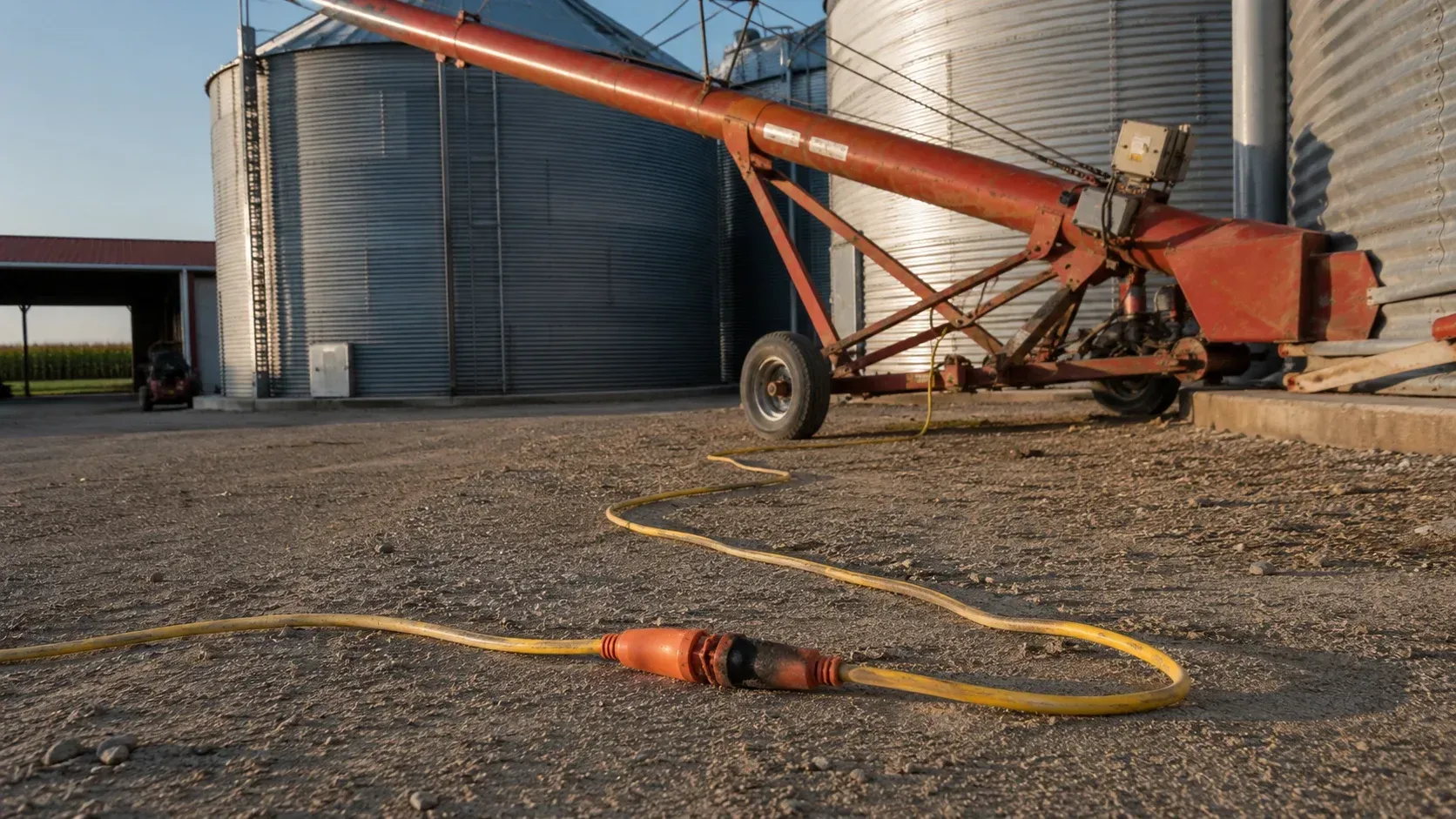
Table of Contents
- What actually goes wrong
- Why a motor on low voltage draws more current, not less
- The cord gets hot too
- Starting under load is the worst case
- Grain dust changes the stakes
- Why flexible cord is not permanent wiring
- The failures we get called out for
- What a proper grain-handling circuit involves
- What to do if a cord feed is what you have right now
- Conclusion
- Get a Dedicated Circuit Installed Before Next Harvest
- Frequently Asked Questions
Key Takeaways
- An extension cord long enough to reach a bin drops voltage, and a motor fed low voltage draws more current to produce the same torque. More current means more heat in the windings.
- Heat is what kills the motor. Insulation on the windings degrades with sustained overheating, and a burned-out auger motor mid-harvest costs far more than the circuit would have.
- The cord itself heats up over its whole length, and a coiled cord has nowhere to shed that heat. Damaged insulation, wet connections, and no reliable ground path stack on top of that.
- Starting an auger under a full load is the worst case, because a motor drawing locked-rotor current through an undersized cord heats everything fastest.
- Grain dust is combustible, which means a hot cord or an arcing connection in a bin area is an ignition source in exactly the wrong place.
Introduction
Running a grain bin auger on an extension cord drops voltage across the length of the cord, and a motor receiving less voltage than it was designed for draws more current to do the same work. That extra current turns into heat in the motor windings and in the cord, and sustained overheating is what destroys motor insulation. The end of that path is a failed auger motor, and in the wrong conditions, an ignition source sitting in a dust-laden environment.
We get these calls every fall, usually the same way: an auger that has worked fine on a cord for three seasons finally will not start, or starts and then trips, or comes back smelling like a burned motor. It is one of the more common shortcuts on working farms, and it is one of the few where the failure lands during harvest, which is the most expensive week of the year to lose equipment. Getting dedicated circuits for farm equipment installed ahead of the season is straightforward work; replacing a motor at 10pm in October is not.
Here is the mechanism, why it is worse for augers than for most tools, and what a proper feed looks like.
What Actually Goes Wrong
Three things happen at once, and they compound.
Voltage arrives at the motor lower than the nameplate, because some of it is lost as heat along the cord. The motor compensates by drawing more current. And the higher current heats both the motor windings and the entire length of the cord.
None of it announces itself immediately. The auger still turns. It may sound slightly labored, or run warmer than it used to, or trip a breaker occasionally on startup. Because it works, the arrangement stays in place, and every season of running it that way takes a little more life out of the motor insulation. Motors do not usually fail the first time they overheat. They fail after they have overheated repeatedly.
Why a Motor on Low Voltage Draws More Current, Not Less
This is the part that trips people up, because intuition runs the other way. Less voltage sounds like it should mean less current and a gentler load on everything.
An induction motor turning a mechanical load has to produce a certain torque, and torque takes power. Power is roughly voltage times current, so if voltage at the motor terminals drops and the mechanical work stays the same, current has to rise to make up the difference. The motor is not choosing to be gentle; it is being asked for the same output with less to work with.
The extra energy becomes heat in the windings, and winding heat rises with the square of the current, so a modest increase in current produces a considerably larger increase in heating. That is why voltage drop matters far more for motor loads than for a string of lights, which would simply run dimmer and be fine.
The other consequence is torque. Induction motor starting torque falls off sharply as voltage drops, which causes the failure we get called about most: an auger that starts when the bin is nearly empty and refuses when it is full.
The Cord Gets Hot Too
The motor is not the only thing absorbing the loss. Every foot of that cord has resistance, and current flowing through resistance produces heat along the whole run.
Several things make it worse in practice on a farm:
Undersized gauge. Shop cords are usually sized for hand tools, not a continuous motor load at a distance. Gauge is the single biggest factor in how much voltage a cord drops, and a longer cord of the same gauge drops proportionally more.
Coiling. A cord coiled on the ground or left partly on a reel cannot shed heat, and the middle of the coil is the hottest part of the run and the part nobody looks at.
Daisy chaining. Cords end to end multiply the length and add connections, and every connection is a potential high-resistance point.
Damaged insulation. Farm cords get run over, pinched in doors, dragged on concrete, chewed by rodents, and left in the sun. Nicked insulation in a damp or dusty location is a fault waiting for conditions.
Wet and dusty connections. Cord-to-cord joints lying near a bin see moisture, dust, and grain, none of which belongs in a connection carrying a motor load.
No reliable ground path. A ground compromised anywhere along a chain of cords means a fault that should trip a breaker may instead energize the frame of the equipment someone is standing next to.
Starting Under Load Is the Worst Case
Auger motors are asked to start against resistance more often than most farm motors, and starting is when current is highest.
A motor drawing its inrush current is pulling multiples of its running current for those few seconds. Push that through an undersized cord and the voltage at the motor sags hard right when it needs voltage most. If torque falls below what it takes to break the load loose, the rotor does not turn, and a motor that is energized but not turning is drawing locked-rotor current with none of the cooling that comes from running.
That condition heats windings extremely fast. It is why a motor that has tolerated a cord feed for years can be destroyed in one afternoon of trying repeatedly to start a full bin, and why repeated reset-and-retry is the most damaging thing you can do at that moment.
If your auger has started getting fussy about starting when the bin is full, that is not the auger getting old. That is a voltage problem telling you what it is.
Grain Dust Changes the Stakes
Everything above would be true of any motor on a long cord. What makes grain handling different is the atmosphere the equipment runs in.
Grain dust is combustible. Augers, legs, and bin unloading generate it, and it settles on everything nearby including cords and connections. A hot cord or an arcing plug in a dust-laden area is an ignition source where ignition sources do not belong.
Dust also insulates. A cord or motor buried in accumulated fines cannot dissipate heat, so it runs hotter than the same equipment in clean air, which loops back into everything above.
This is the reason we will not install a cord-fed arrangement around grain handling and call it finished, even temporarily. It is not just an equipment-protection question at that point.
Why Flexible Cord Is Not Permanent Wiring
There is a principle behind all of this that is worth knowing, because it explains why an electrician will push back on a cord feed even when the cord is heavy enough.
Flexible cord is intended for temporary and portable use. It is not intended to serve as the permanent wiring method for equipment that has a fixed location and gets used season after season. Permanent wiring is protected in raceway or cable, sized for the load and the distance, supported properly, and provided with a disconnecting means. A cord running out a door to a bin meets none of that.
That distinction is not merely bureaucratic. Everything about permanent wiring exists to handle the exact failure modes described above: correct sizing so voltage arrives where it should, physical protection so insulation is not damaged, and a fault path that reliably clears.
It also matters if something goes wrong. A loss traced to equipment permanently fed by an extension cord invites questions from an insurer that a properly installed circuit does not.
The Failures We Get Called Out For
In rough order of how often we see them:
A motor that will not start when the bin is full but will when it is nearly empty. Almost always voltage drop, almost always fixed by a proper feed rather than a bigger motor.
A burned-out auger motor. The customer usually knows how it happened by the time we arrive.
A breaker that trips on startup. Sometimes it is doing exactly what it should; occasionally it points at something worse upstream, which is worth checking rather than assuming, and it can overlap with the symptom our post on a warm electrical panel covers.
A melted plug or receptacle, because that connection was the highest-resistance point in the run.
Equipment added to a building over the years until its supply cannot carry it. Grain handling often exposes this as a large load added late, which is what our post on whether a farm electrical system is overworked is really about.
What a Proper Grain-Handling Circuit Involves
For the sake of knowing what you are buying, here is what actually goes into doing it right.
We start with the equipment nameplate. Motor full-load amperage, voltage, and phase set the conductor sizing and overcurrent protection, and the distance from the source determines whether that conductor needs to be larger than the load alone would require so voltage arrives within tolerance. That distance calculation is the step a cord skips entirely.
Then the physical installation: conductors in a wiring method suited to the location and protected where exposed, a disconnecting means the operator can reach so equipment can be isolated without walking back to a panel, motor overload protection, and enclosures and fittings rated for a dusty and often damp environment rather than a clean indoor wall.
Then the supply side. If the bin site sits a distance from existing service, getting power there may mean a new run or electric pole installation out to where the equipment lives, which is common where a grain setup grew up away from the original yard.
Three-phase equipment deserves a specific note. If your auger or leg is three-phase, an extension cord arrangement is not a shortcut, it is simply not an option, and the supply question needs answering properly.
What to Do If a Cord Feed Is What You Have Right Now
Harvest does not wait for an electrician, so here is the honest interim guidance.
Uncoil the cord completely so it can shed heat, and keep it out of traffic and standing water. Use the heaviest gauge and shortest length that will reach, and do not daisy chain. Check the cord, plug, and receptacle for damage and for heat during use, and stop if any part is hot. Keep dust off the connections. Do not repeatedly reset and retry a motor that will not start, because that is the fastest way to destroy it.
Then get it corrected before next season rather than after the motor fails. A dedicated circuit booked in the off season costs less and is scheduled at your convenience instead of during the week you can least afford to stop. Other operations across our service areas have gone that route, as our reviews page reflects, and if you are unsure what your auger needs, the nameplate tells us most of it over the phone. Our overview of what electric farm equipment involves is a starting point for a larger setup.
Conclusion
An extension cord feeding a grain auger drops voltage, the motor answers by drawing more current, and the extra energy becomes heat in the windings and along the cord. That is what wears out motors, and in a dust-laden bin area it is also what puts an ignition source somewhere it should never be.
The fix is not a heavier cord. It is a circuit sized for the motor and the distance, run in a method suited to the location, with a disconnect the operator can reach. It is a modest job done in the off season and an expensive one done in the middle of harvest, and that timing is really the whole argument.
Get a Dedicated Circuit Installed Before Next Harvest
If your grain handling is running on a cord, let us size and install a proper circuit for it while the season is quiet. We have done agricultural electrical work across Northeast Iowa and the Tri-State area since 2005, we are fully licensed and insured, and we are a J&D Manufacturing authorized dealer and Generac dealer serving working farms. Our phone is answered 24/7 at (563) 419-8218. Get in touch with your auger's nameplate details, or a photo of the plate, and we can tell you what the circuit needs before we come out.
Frequently Asked Questions
Can you run a grain auger on an extension cord?
It will often turn, which is why the practice persists, but the cord drops voltage and the motor compensates by drawing more current and running hotter. Flexible cord is intended for temporary use, not as permanent wiring for fixed equipment.
Why does my auger start when the bin is empty but not when it is full?
Almost always voltage drop. Induction motor starting torque falls off sharply as voltage at the terminals drops, so there is enough torque to start a light load and not enough for a full one. A properly sized circuit usually resolves it.
Will a heavier extension cord fix the problem?
A heavier gauge reduces voltage drop and helps, but it does not address physical protection, a reliable fault path, a disconnecting means, or the fact that cord is not a permanent wiring method. It is a stopgap, not a fix.
Why is grain dust a factor in electrical safety?
Grain dust is combustible and it settles on cords, plugs, and motors. A hot cord or an arcing connection becomes an ignition source, and accumulated dust also traps heat so equipment runs hotter than it would in clean air.
What does a dedicated auger circuit need?
Conductors are sized for the motor's full-load amperage and for the distance so voltage arrives within tolerance, overcurrent and overload protection, a disconnect within the operator's reach, and enclosures rated for a dusty, often damp location.
Related Posts