What Happens If You Ignore a Warm Electrical Panel on Your Farm?
CONTACT US
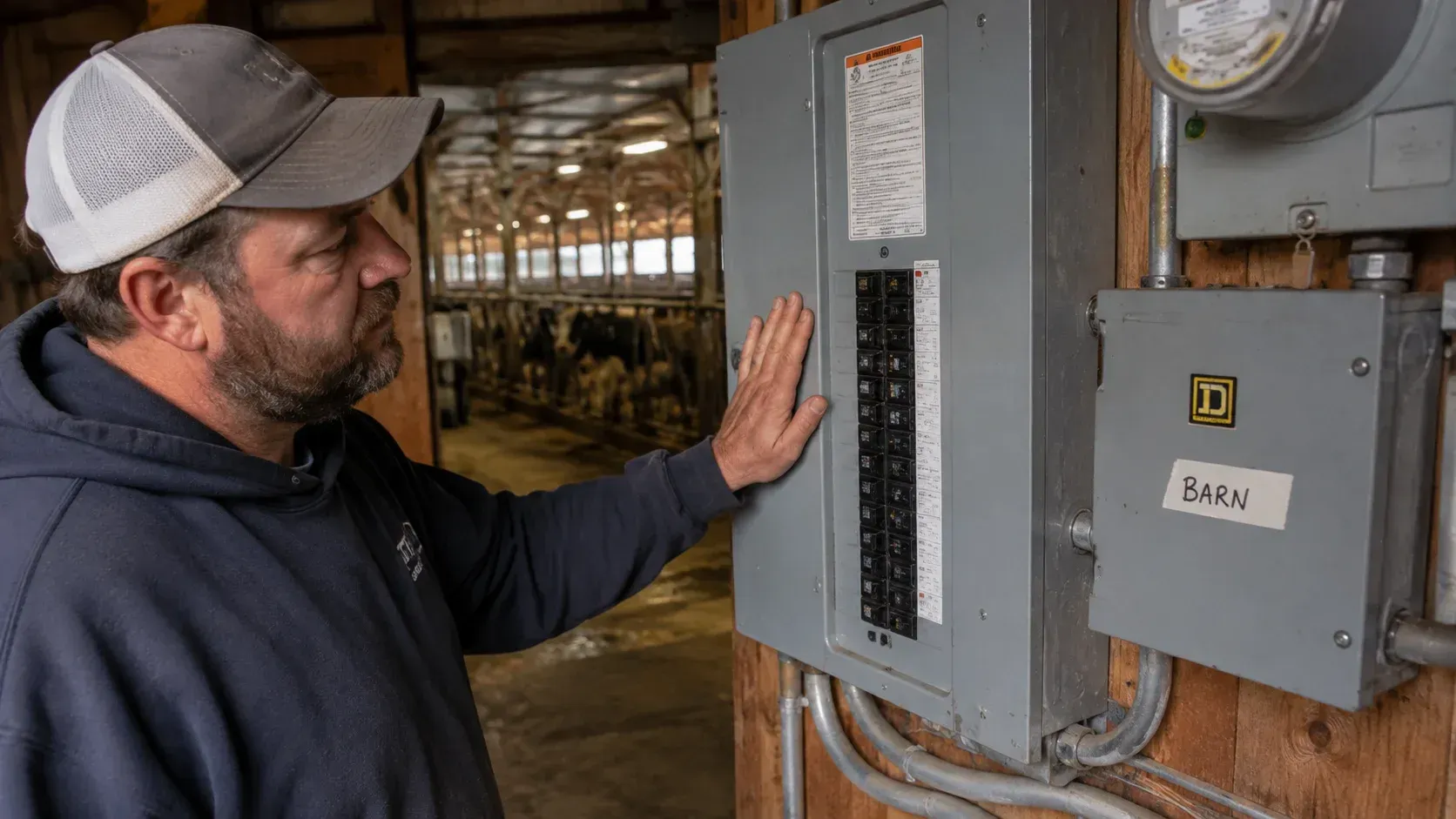
Table of Contents
- Introduction
- What a warm panel actually means
- Why the problem gets worse instead of leveling off
- Where the heat is usually coming from
- Warm, or a problem: how to tell the difference
- Why barn and shop panels fail faster than house panels
- What ignoring it leads to
- What to do tonight, and what not to do
- What we actually check when we open a panel
- When it is the utility's side and not yours
- Conclusion
- Request a Same-Week Panel Inspection
- Frequently Asked Questions
Key Takeaways
- A warm panel cover almost always means resistance heating at a loose or corroded connection. Electricity forced through a bad connection turns into heat at that exact point.
- The problem is self-worsening. Heat damages the connection, the damaged connection has more resistance, and more resistance makes more heat. It does not stabilize on its own.
- A buzzing sound, a burning or fishy plastic smell, discoloration around a breaker, or a specific hot spot on the cover are all escalation signals, not maintenance items.
- Do not remove the panel cover to look. The failing connection is often on energized parts that are not protected once the cover is off.
- Barn and shop panels fail sooner than house panels because of dust, ammonia, humidity, temperature swings, and constant motor vibration.
Introduction
A warm electrical panel on your farm almost always means current is passing through a connection that is no longer tight, and that connection is turning electricity into heat instead of passing it along cleanly. Left alone, it does not settle down. The heat degrades the connection further, which raises resistance, which produces more heat, and the end of that path is an arc inside a metal box, in a building full of hay, dust, or livestock.
That is the short version, and it is why we treat a warm panel as a same-week call rather than something to keep an eye on. It is also one of the few electrical problems where the symptom you can feel with the back of your hand tells you something genuinely useful. If you want the broader picture of the farm electrical services side of this, panel work is a large share of what we do across Northeast Iowa.
Here is what is happening inside that box, how to tell normal warmth from a real problem, and what to do first.
What a Warm Panel Actually Means
Electricity moving through a properly made connection loses very little energy. Tighten a lug to spec on a clean conductor and current crosses it without much resistance and without much heat.
Loosen that same connection, corrode it, or let vibration work it over a few seasons, and the contact area shrinks. Current still has to get through, so it crowds into a smaller path, and the energy that used to pass through cleanly now converts to heat right at the bad spot. That is resistance heating, and it is the single most common reason a panel enclosure feels warm.
The important part is where the heat originates. It is not the panel warming as a whole. It is one joint, usually a breaker connection or a terminal screw, getting hot enough that heat spreads through the enclosure until you feel it outside. By the time the cover is noticeably warm, the connection behind it is considerably hotter.
Why the Problem Gets Worse Instead of Leveling Off
This is the part worth understanding, because it explains why waiting is the wrong call even when nothing has failed yet.
Heat at a connection oxidizes the metal and anneals the spring tension out of whatever holds it tight. A screw terminal heated and cooled through many cycles does not hold the way it did, so the connection loosens, the contact area shrinks, resistance climbs, and the temperature goes up again. Each round makes the next worse.
Farms accelerate this because loads cycle hard. A compressor, vacuum pump, grain leg, or fan bank pulls heavily at startup then drops back, and those swings heat and cool the connection repeatedly instead of holding one steady temperature. Thermal cycling is what actually kills terminations, and a working farm delivers more of it than a house does.
Where the Heat Is Usually Coming From
When we find the source, it is almost always one of these:
- A breaker's connection to the bus. The stab or bolt where a breaker meets the busbar is a spring or bolted contact, and it is the most common single failure point.
- Feeder or main lugs. The large terminations where service conductors land. These are torque-critical, and under-torqued and over-torqued lugs both fail, just differently.
- Neutral and ground bar screws. Easy to under-tighten at installation and easy to overlook afterward.
- Aluminum conductor terminations. Aluminum expands and oxidizes differently than copper, so its connections need the right compound, lugs, and torque. Missing any of that, they run hot. This is common in rural buildings of a certain age, and it is worth knowing whether your branch circuits are aluminum, which we will cover for Allamakee County properties.
- A breaker failing internally. Breakers are mechanical and they wear. One that has tripped many times, or sat in a hot damp panel for decades, can develop resistance inside itself.
Note what is not on that list: the panel being "too small." An undersized service is a real problem and it causes different symptoms, mostly nuisance tripping and voltage sag rather than a localized hot spot. Capacity and heat are two separate conversations, and if your concern is that you have added equipment faster than your service has kept up, that is the question our post on whether a farm electrical system is overworked addresses.
Warm, or a Problem: How to Tell the Difference
Some warmth is not an emergency. A panel carrying a heavy sustained load can feel slightly above room temperature, and a panel in an unconditioned machine shed in August is warm because the building is. What moves it from normal to call-now:
- A distinct hot spot rather than general warmth, especially over a specific breaker
- Warmth that persists when the big loads are off
- Any buzzing, crackling, or sizzling
- A smell of hot plastic, or the sharp fishy odor overheated breaker components give off
- Brown or blackened discoloration on the cover or around a breaker
- A breaker that feels hot when the others feel cool
- Lights dimming across the building when a large motor starts
- A breaker tripping without an obvious new load
Any one of those is enough. Two or more together, and I would not wait for morning.
Why Barn and Shop Panels Fail Faster Than House Panels
Panels in agricultural buildings live a harder life than the one in a farmhouse basement, and it changes the maintenance picture.
Dust. Grain, feed, and bedding dust settle into enclosures and onto terminations, and dust holds moisture and traps heat where you least want it held.
Ammonia and manure gases. Livestock housing has a corrosive atmosphere. Ammonia attacks copper and its alloys, and corroded contact surfaces are exactly the high-resistance connections this article is about.
Humidity and condensation. Milk houses, wash areas, and unheated buildings that swing through the dew point put moisture inside enclosures, and corrosion follows.
Vibration. Panels sharing a wall or post with running motors, augers, or fans get shaken continuously, and vibration is how a properly torqued screw becomes a loose one.
Rodents. They nest in enclosures and chew insulation.
Two practical consequences. The enclosure type matters as much as the panel, and plenty of farm panels sit in the wrong one for their environment. And agricultural panels benefit from scheduled inspection rather than only crisis attention, which is the argument behind our piece on how often barn wiring should be inspected.
What Ignoring It Leads To
The escalation path is fairly predictable.
First, nuisance behavior. Breakers trip at loads they used to carry, lights flicker, and motors run hot or hum oddly, because a bad connection upstream is dropping voltage and a motor fed low voltage draws more current to do the same work.
Then equipment damage. Motors, controllers, and electronics fed inconsistent voltage fail early. On a dairy that shows up in the parlor; in a shop, in a welder or compressor.
Then the connection fails outright. When a terminal degrades far enough, current starts jumping the gap rather than crossing metal to metal, and arcing inside a panel produces temperatures far beyond what the enclosure, the insulation, or anything nearby is built for.
Then, in the worst case, ignition. This is why we push on it. A farm building fire is not comparable to a house fire, both because of what is stored in these buildings and because of what is living in them, and rural response times are longer.
One more consequence worth naming: a fire traced to a known, unaddressed electrical fault becomes a conversation with your insurer that you do not want to have.
What to Do Tonight, and What Not to Do
If you have just put your hand on a warm panel, here is the order of operations.
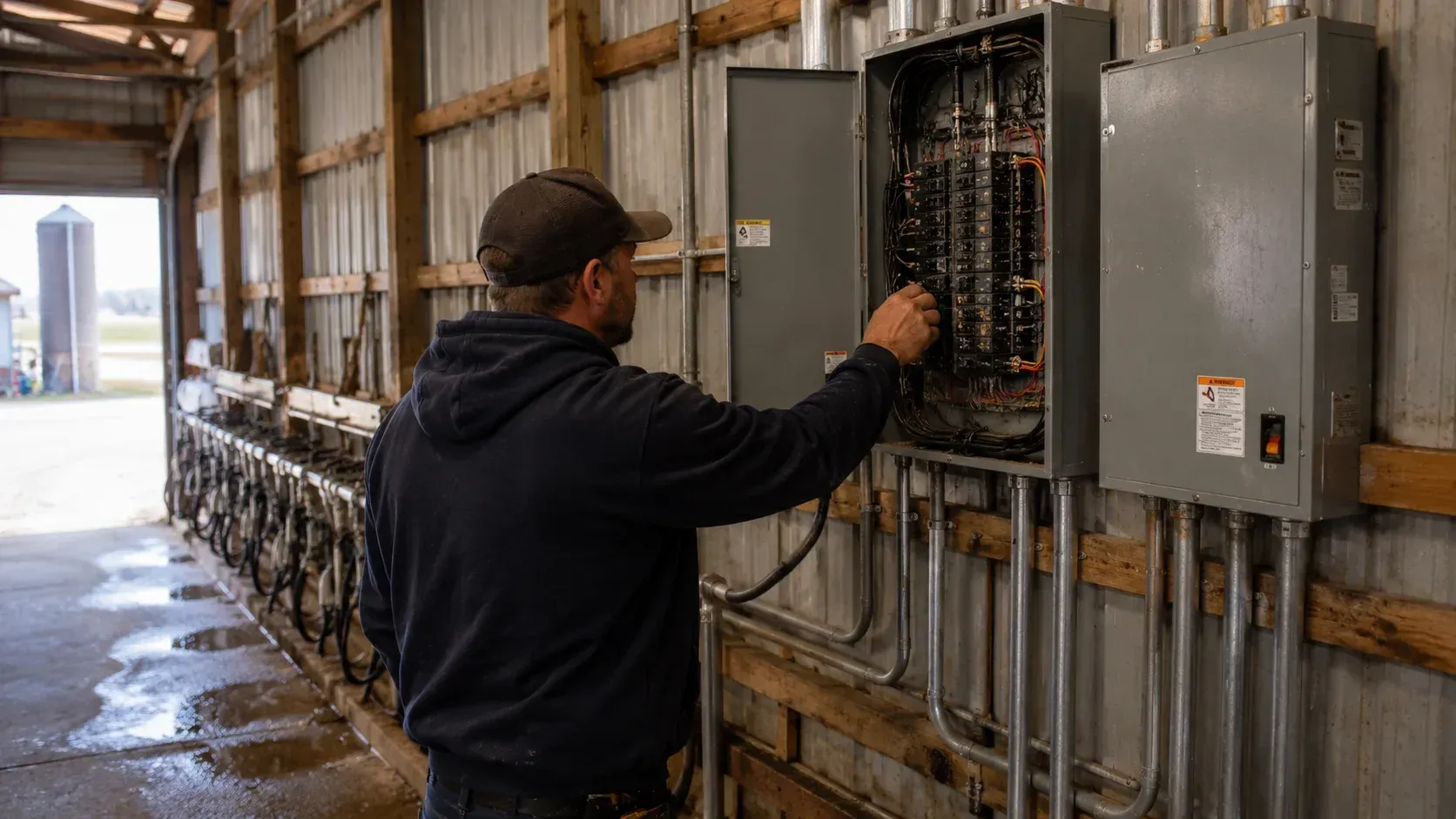
Do not remove the cover. This is the one thing I would ask most firmly. Once the cover is off, energized busbars and lugs are exposed, and the very connections that are failing are the ones you would be reaching near. There is nothing you can diagnose visually that is worth that risk.
Reduce the load if you can do it safely. Turning off equipment on that panel at the equipment itself, not at the panel, lowers the current going through the bad connection and buys time.
If you smell burning plastic, hear arcing, or see smoke, treat it as an emergency. Get people and, where practical, animals away from the building, and call the fire department. Do not open the panel to investigate.
If it is warm but stable with no smell or noise, shut off the circuits you can live without and call us. Our phone is answered around the clock at (563) 419-8218 for exactly this reason.
Do not keep resetting a breaker that trips. A breaker that trips is doing its job. Repeated resets on a fault heat everything further.
Do not have someone re-torque terminations with the panel energized. Working a live panel is skilled, hazardous work, and tightening a hot connection under load is not a fix. The heat has usually already damaged the metal.
What We Actually Check When We Open a Panel
We de-energize before working inside, and we look for the heat signature first, because discoloration and smell usually point at the culprit before anything is measured. We check terminations and torque them to the values the equipment calls for rather than by feel, paying particular attention to aluminum terminations, breaker-to-bus contact surfaces, the neutral and ground bars, and the condition of the bus itself, since a bus that has been arced on cannot simply be re-tightened.
We also check whether the panel suits where it is living: enclosure rating for the environment, mounting away from vibration, working clearance in front of it, and conductor sizing for the loads that have accumulated. On a lot of farms the panel suited the operation in 1990 and has had two decades of equipment added since.
Then we tell you what we found, including when the honest answer is that the panel is past economical repair. Whether the work is in Harpers Ferry or anywhere else across our service areas, that conversation is the same.
When It Is the Utility's Side and Not Yours
One clarification that saves people money and confusion. The equipment on your side of the meter is yours to maintain. The service drop, the meter, and everything upstream belong to your power provider, so heat, arcing, or damage at or before the meter is a call to the utility rather than to an electrician.
If you are not sure which side of that line your problem sits on, describe what you are seeing when you call and we can usually tell you before anyone drives out. We would rather point you at the right party than bill you for a trip that was never ours to make, and our reviews page reflects how that tends to go.
Conclusion
A warm panel is a bad connection converting electricity into heat, and bad connections get worse rather than better. The escalation runs from nuisance tripping through equipment damage to arcing, and the last step in that sequence is a building fire in a place where fires are especially costly and help is especially far away.
The right response is unglamorous. Do not open the cover, drop what load you safely can, and get a licensed electrician to look inside it de-energized. Almost every one of these we find early turns out to be a repair measured in hours. The ones that get ignored are the ones that stop being repairs.
Request a Same-Week Panel Inspection
If the cover on your panel feels warm, call us and we will get out to look at it this week. We have been doing agricultural and rural electrical work since 2005, we are fully licensed and insured, and our phone is answered 24/7 at (563) 419-8218 because farm electrical problems do not keep business hours. We cover
Harpers Ferry and the surrounding area along with Winneshiek, Allamakee, Fayette, and Dubuque Counties in Iowa and Crawford, Vernon, and La Crosse Counties in Wisconsin.
Get in touch and tell us what you are feeling, hearing, and smelling, and we will tell you whether it can wait until morning.
Frequently Asked Questions
Is it normal for an electrical panel to feel warm?
Slight warmth under sustained heavy load can be normal, especially in an unconditioned building. A distinct hot spot, warmth that persists when loads are off, buzzing, discoloration, or a burning plastic smell are not normal and need a licensed electrician promptly.
Should I open the panel to see what is hot?
No. Removing the cover exposes energized busbars and lugs, including the failing connection itself. Nothing you could see is worth that risk. Leave the cover on, reduce load at the equipment, and have it inspected de-energized.
What causes a warm electrical panel?
Almost always resistance heating at a loose or corroded connection, most often where a breaker meets the busbar, at feeder lugs, at neutral and ground bar screws, or at aluminum terminations. Current crowding through a poor contact converts to heat there.
Why do barn panels overheat more than house panels?
Dust, ammonia and manure gases, humidity, temperature swings, and constant motor vibration all attack terminations. Vibration loosens screws and corrosion raises resistance, which is exactly the condition that produces heat.
Can a warm panel really start a fire?
Yes. As a connection degrades, current begins arcing across the gap rather than crossing metal to metal, and arcing reaches temperatures far above what the enclosure and nearby materials tolerate. This is why a warm panel is treated as urgent rather than routine.l choice.
Related Posts