Why Do LED Barn Lights Flicker in Cold Weather When Incandescent Bulbs Didn't?
CONTACT US
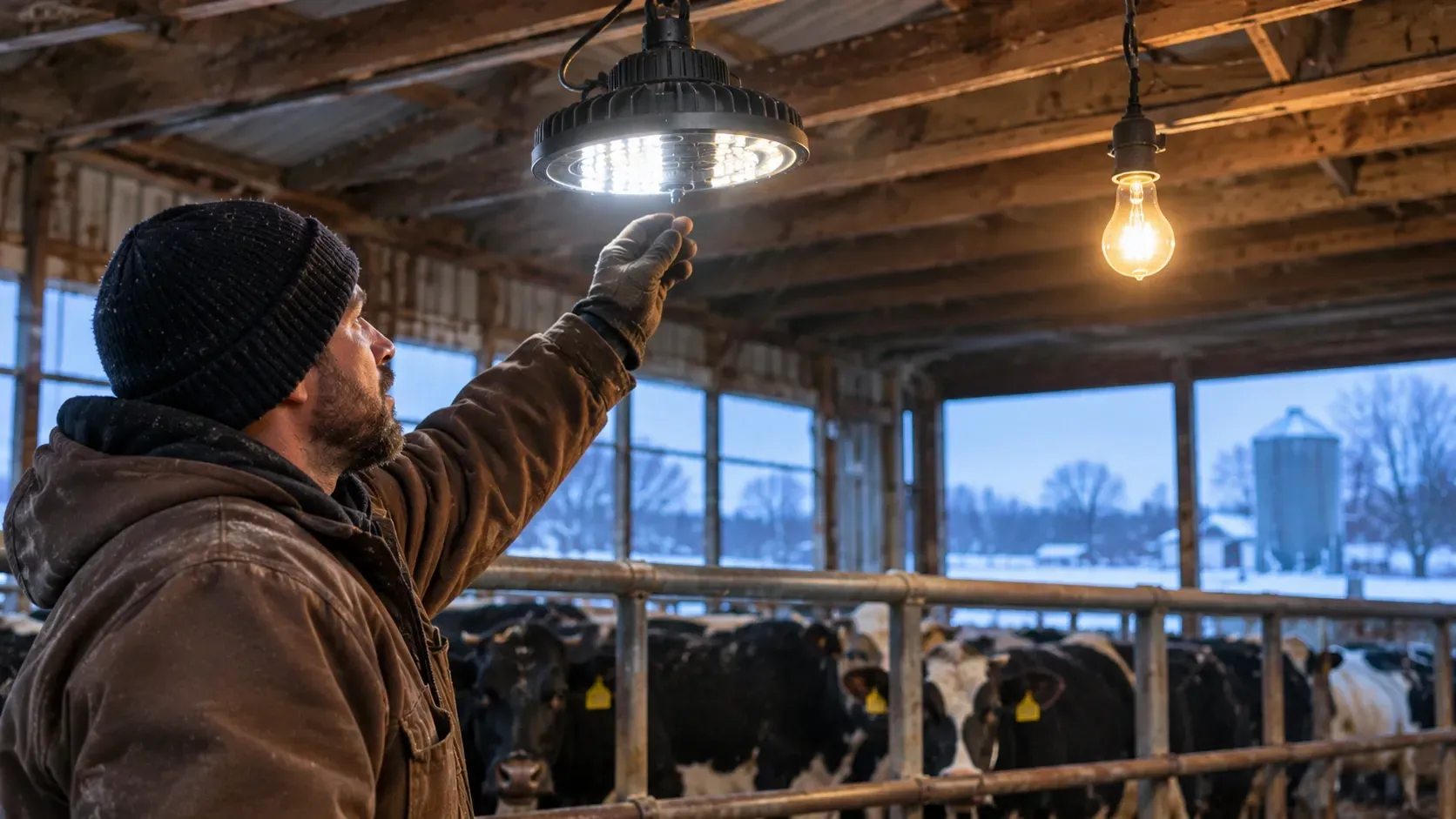
Table of Contents
- Introduction
- Why LED Barn Lights Flicker When Incandescent Did Not
- The Driver Is the Part That Minds the Cold
- What the Old Bulbs Were Doing Differently
- Rule These Out Before You Blame the Cold
- Why Barns Are Harder on Fixtures Than Houses
- What a Cold-Rated Fixture Actually Changes
- Conclusion
- Lights Stuttering in an Unheated Building?
- Frequently Asked Questions
Key Takeaways
- It is the driver, not the diodes. The electronics mind the cold, the light-producing part does not.
- An incandescent bulb was a filament and nothing else. There was nothing in it for cold to affect.
- If it only happens on the coldest nights, that is the driver. All year round means something else.
- Motors starting on the same circuit make LEDs blink where old bulbs barely showed it.
- Fixtures carry a rated temperature range. An unheated barn needs one specified for it.
Introduction
Because an LED fixture has electronics in it and the old bulb did not, which is why LED farm lighting is worth specifying properly for an unheated building: every LED light contains a driver that converts incoming AC into the low-voltage DC the diodes run on, and the components inside that driver behave differently when it is cold.
So LED barn lights that were never specified for a barn start to stutter in January.
The irony is that the LEDs themselves are perfectly happy. Cold is good for them.
Why LED Barn Lights Flicker When Incandescent Did Not
Two completely different technologies, and only one of them has a circuit board in it.
An incandescent bulb was a wire that glowed when you ran current through it. That is the entire device. Nothing in it could be upset by temperature, because there was nothing in it but a filament, some gas and glass.
An LED fixture is a small power supply with light-emitting diodes attached. The power supply is the driver, and it is where every cold-weather complaint we get traces back to. When somebody tells us their LED barn lights flicker, blink on startup, or take a few seconds to come up to full brightness once the temperature drops, we are already thinking about the driver before we have seen the building.
The Driver Is the Part That Minds the Cold
Here is what is actually happening inside the fixture.
A driver contains capacitors, and the electrolytic ones in particular lose performance as the temperature falls. The electrolyte becomes more viscous. Effective capacitance drops and internal resistance climbs.
A driver that regulates current smoothly at room temperature then starts regulating it unevenly, and uneven current through an LED array is visible as flicker.
The startup moment is the hardest part. Driver circuits have to establish themselves before they settle into steady operation, and a cold driver is working against components that are not performing to specification yet. That is why the symptom is so often worst in the first minute and then improves as the fixture generates a little of its own warmth.
Meanwhile the diodes are doing fine. LEDs actually run slightly more efficiently in cold conditions, because heat is what degrades their output and lifespan. The light-producing part of the fixture likes your barn. The power supply attached to it does not, unless somebody chose one that was built for it.
What the Old Bulbs Were Doing Differently
Worth saying plainly, because people remember the old lights as more reliable and in this one narrow respect they were.
An incandescent bulb could not flicker from cold because it had no circuitry to misbehave. Plug it into power and the filament heated up, every time, at any temperature a barn is likely to see.
What it also did was convert most of the energy you paid for into heat rather than light. That is the trade people made when they switched, and nobody looking at a power bill wants to go back. The old bulbs were not better. They were simpler, and simplicity is what made them indifferent to the cold.
So the right conclusion is not that LEDs were a mistake. It is that LEDs have a component the old ones did not, and that component has a specification that matters in an unheated building.
Rule These Out Before You Blame the Cold
Do not buy new fixtures until you have checked these, because several of them are more common than driver failure and all of them are cheaper to fix.
- A dimmer or switch that is not LED compatible. Old dimmers built for incandescent loads cause flicker in LEDs year round.
- A loose connection. In a barn this is a live possibility. Fans vibrate, rodents chew, and moisture gets into boxes. A loose termination flickers in any weather.
- Voltage drop on a long run. Power going a fair distance out to an outbuilding arrives lower than it left, and a marginal fixture shows it.
- Motors sharing the circuit. A ventilation fan or a curtain motor starting draws a surge that dips the voltage briefly. Incandescent barely showed it. LEDs blink. If the flicker happens exactly when something kicks on, this is your answer, not the weather.
- Moisture or dust inside the fixture. A fixture that is not sealed for the environment eventually gets contaminated.
- The fixture is simply failing. Drivers have a service life.
The quickest diagnostic is seasonal. If it only happens on the coldest nights and settles once things warm up, you are looking at a driver and its temperature rating. If it happens in July as well, work down the list above. A circuit that has quietly ended up pulling more current than it was built for will show up this way too, which is the same reasoning behind giving heavy equipment its own dedicated circuit.
Why Barns Are Harder on Fixtures Than Houses
A fixture that would last years in a garage can have a short life in a livestock building, and the cold is only part of it.
Barns combine conditions that no residential fixture was designed around:
- No heat. The fixture sees whatever the weather is doing, overnight, all winter.
- Dust. Feed and bedding dust gets everywhere and insulates things that were meant to shed heat.
- Moisture and washdown. Parlors and livestock areas are wet environments.
- Ammonia and manure gases. Corrosive to electronics and contacts over time.
- Vibration. Fans, augers and doors shake fittings loose.
- Rodents. They chew, and they prefer sheltered wiring.
The practical consequence is that fixture selection for a barn is a specification exercise rather than a shopping trip. Cold rating, sealing, and corrosion resistance all matter, and the cheapest fixture that produces the right light output is very often the wrong purchase.
What a Cold-Rated Fixture Actually Changes
It changes the driver, mostly, and the housing around it.
Fixtures are built and tested to an operating temperature range, and that range is published for the product. A fixture specified for an unheated building in this climate uses driver components selected to hold their behaviour at the low end of what an Iowa winter does, rather than ones chosen for an office ceiling. Sealed, damp or wet rated housings keep the dust and moisture off those components so they last.
We sell and install LED lighting for barns, parlors, machine sheds and yards, and the specification conversation is the useful part of that. What the building is, whether it is heated, how it gets washed, what is running on the same circuits, and how high the fixtures sit all change the answer.
For farms around Decorah and across the counties we cover, getting that right once is considerably cheaper than replacing fixtures twice. It also matters for the same reason winter outages matter: lighting you cannot rely on in a livestock building in January is not a cosmetic problem.
Conclusion
Watch when it happens before you spend anything. Flicker only on cold nights, easing off after the lights have been on a while, points at the driver and its temperature rating. Flicker that tracks a fan or a motor starting points at the circuit. Flicker all year round points at a dimmer, a loose connection or a fixture on its way out. Those three lead to three different fixes, and the cheapest mistake in barn lighting is buying new fixtures to solve a problem that was never in the fixture.
Lights Stuttering in an Unheated Building?
Tell us what the building is and when the flicker happens and we can usually narrow it down before we are out there. We sell and install LED lighting for barns, parlors, machine sheds and yards, and we will specify fixtures for the conditions the building actually sees rather than the ones a catalog assumes. Whit's Electric has been local since 2005, more than 20 years around Harpers Ferry, Waukon, Decorah, Postville and across Allamakee, Winneshiek, Fayette and the Wisconsin counties. We are a fully licensed and insured electrical business, open 24/7. Call (563) 419-8218 or
call us to get on the schedule.
Frequently Asked Questions
Why do my LED lights flicker when it is cold?
Because of the driver, the electronics inside the fixture that convert AC to the DC the diodes need. Its capacitors lose performance in cold, which makes current regulation uneven and shows up as flicker. The LEDs themselves are unaffected by cold.
Do LEDs work in freezing temperatures?
The diodes work very well in cold, better than in heat. Whether the fixture works depends on the driver, which is built and tested to a published operating temperature range. A fixture specified for an unheated building handles winter fine.
Why did my old incandescent bulbs never flicker in the cold?
Because they had no electronics in them. An incandescent bulb was a filament that glowed when current ran through it, so there was nothing inside for temperature to affect. They also wasted most of their energy as heat, which is why they were replaced.
My LED barn lights flicker all year, not just in winter. Why?
That points away from the cold. Check for an incompatible dimmer, a loose connection, voltage drop on a long run to an outbuilding, or motors starting on the same circuit. Each of those flickers in any weather.
Are barn fixtures different from regular LED fixtures?
They should be. Barns are unheated, dusty, damp, corrosive from ammonia, and full of vibration. Fixture selection for a livestock building is a specification exercise covering cold rating, sealing and corrosion resistance, not just light output.
Related Posts